
Last Updated December 2, 2025
If you’re dreaming of life in Southwest Florida, you’re probably picturing sunshine, palm trees, and friendly, active communities built around that easygoing Florida lifestyle. And one thing you’ll quickly notice is how central pickleball in Venice, Florida, has become to that way of life, from neighborhood courts to public parks and full-on pickleball clubs.
And honestly, we get asked about it all the time: What even is pickleball? Why is everyone so obsessed with it? And most importantly, where can you play pickleball in Venice and Sarasota?
This fast-growing sport has become the heartbeat of community life across Venice, Wellen Park, Sarasota, and beyond. It’s social, it’s outdoors, it’s fun for all ages, and it’s showing up in nearly every new-home neighborhood and park around the region.
Whether you’ve played before or are just hearing about it, pickleball has grown into more of a lifestyle than a sport. From public parks to private clubs and resort-style community courts, it’s one of the easiest ways to stay active and meet new people.
Let’s take a closer look at what makes pickleball so popular (why I love it, and why I think you will, too), why it’s perfect for Florida living, and where you can jump in to play right here on the Gulf Coast.
What is pickleball?
In simple terms, pickleball is a paddle sport that combines elements of tennis, badminton and table-tennis (ping‐pong), but with its own rules, court and pace.
If you’ve played tennis, you’ll recognise a lot of the rhythm, but with pickleball you spend less time racing full-court and more time focusing on positioning, quick reflexes, placement and fun. The game is about control, accuracy, and keeping the play going until someone makes a mistake.
Here’s a quick comparison of the sports so you can see the similarities and differences at a glance:
- Like tennis: there’s a net, you hit a ball over it, there’s strategy of placement and rallying (it’s not about hitting the ball as hard as you can. Instead, it’s about where you hit it and how long you can keep the ball in play.)
- Like badminton: the court is smaller (doubles badminton court size is often used) and the net is usually lower in height.
- Like ping‐pong: the paddle (the bat or racquet) is solid (there’s no strings like Badminton racquets) and the ball is light and perforated.
Key features that make the game distinct:
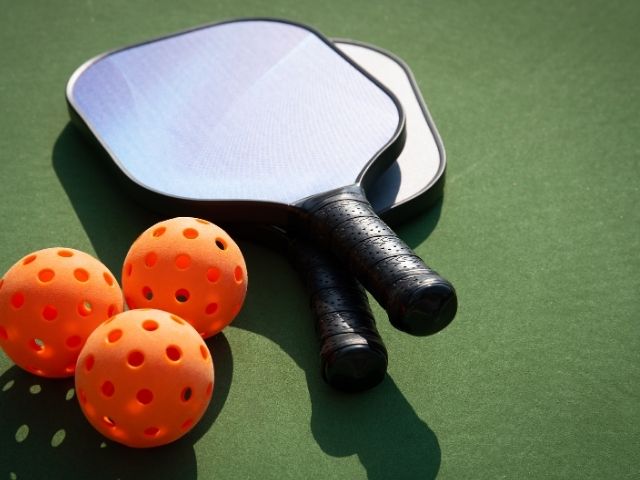
- The ball used is a hard plastic, often perforated (a “wiffle‐type” ball) rather than a tennis ball.
- The paddles are solid faced (composite or wood) rather than strung racquets.
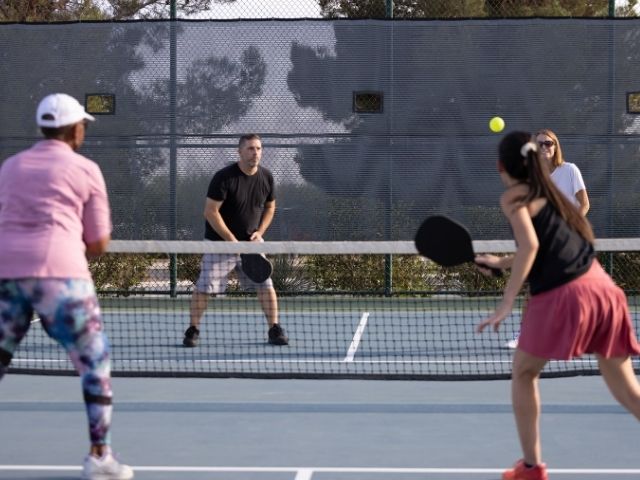
- There’s a “non-volley zone” (often called the “kitchen”) near the net, which is typically 7 ft on each side in outdoor court versions. If you’re standing in this zone, you cannot volley (hit the ball out of the air).
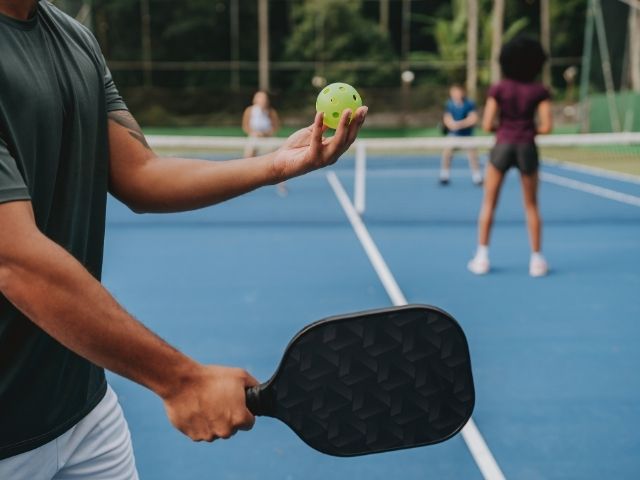
- The serve is underhand (in most standard rules) and the ball must bounce once on each side before volleying.
So in short: if you know tennis, you’ll get the guts of pickleball quickly. Add in the smaller court, the paddle-and-ball twist, and that famous ‘kitchen’ rule, and you’ve got the unique flavor that makes pickleball what it is.
Where did Pickleball come from?
In 1965, on Bainbridge Island, Washington, two dads concocted a game one afternoon to keep their bored children busy. They borrowed badminton nets, ping-pong paddles and a wiffle ball. That improv session ended up creating what we now know as pickleball.
From there it grew. First through retirement communities, rec centres, parks, and now into full-blown nationwide popularity as the fastest-growing sport in the U.S..
Over the decades it spread from the Pacific Northwest into other parts of the U.S., and beyond. We can thank the northern snowbirds for packing their paddles and bringing the game south with them.
In recent years the growth has been explosive: for example one survey notes that in 2024 participation in the U.S. reached about 19.8 million people — a jump of 45.8 % from the year before. It’s thought that this may have happened due to a combination of how inclusive the sport is, the lower barriers to entry, and how well-positioned it was as an outdoor, socially-distanced activity during the Covid pandemic.
How to play pickleball
Now that you know just how popular pickleball has become, maybe it’s starting to sound a little tempting? Or at least you’re curious what all the fuss is about?
If so, you’re in the right place, because I’m a bit of a pickleball fanatic myself and love turning curious newcomers into fellow players. Here’s everything you need to know about how to play pickleball, pickleball rules, how to win at pickleball (because that’s the goal, right?), and why so many people are picking up a paddle and falling in love with the game.
Basic Rules of Pickleball
You already know the basics – smaller court, underhand serve, and that all-important “kitchen” zone where volleys aren’t allowed. Those simple rules keep the game friendly, balanced, and easy for beginners to jump in. But once you start playing a bit more, there are a few other pickleball rules and quirks worth knowing that can really help your game.
- In older versions of the game, if your serve hit the net and still landed in the correct service area, it was called a “let,” and you’d redo the serve.
But not anymore. Now, if your serve hits the net and lands in, it’s a live ball. If it hits the net and lands out, it’s a fault. Simple as that. - Most beginners learn the “don’t volley in the kitchen” rule, but you should also remember that even if you’re outside the kitchen and hit an overhead shot that carries your momentum into the kitchen zone, that’s still a fault and the point goes to the other team, even if it’s an awesome shot.
- Don’t forget that your feet matter more than your paddle. Your feet must stay behind the baseline during the serve. Even leaning too far and losing balance into the court counts as a fault.
- Unlike tennis, there are no do-overs. If your serve is out, that’s it — the serve moves on.
- In tournament or more organized play, players switch sides once one team reaches 6 points (in an 11-point game). This helps balance out things like sun glare or wind.
- For a while, spin serves were the trend. It’s when players would flick or manipulate the ball before hitting it. As of 2023 rule updates, that’s mostly banned. You can still hit with spin from your paddle, but not by spinning the ball with your hand before serving.
Don’t worry, it sounds more complicated than it is. After a game or two, it all starts to feel natural.
How to Score in Pickleball
Pickleball scoring is a bit different from tennis, but once you get it, it makes sense. In recreational play, only the serving team can score points, and most games are played to 11 points (you have to win by at least two). Some competitive matches go to 15 or 21.
You win a point when your opponent fails to make a legal return. For example, if the ball bounces twice on their side, goes out of bounds, hits the net, or they commit a foul like volleying in the kitchen.
How to Win in Pickleball
Now that you understand pickleball scoring, the real fun begins as you decipher how to win in pickleball.
Beginner Tip: it isn’t about brute force. Because the court is smaller and the ball doesn’t bounce as high, power shots won’t always save you.
Winning comes down to strategy, placement, and teamwork. Aim your shots where your opponents aren’t, focus on steady rallies, and use soft, controlled shots (called “dinks”) to keep your opponents moving and off balance.
Pickleball rewards patience, communication, and positioning just as much as physical strength, which is one reason players of all ages love it.
Pickleball Strategy and Movement
While you’ll pick up a lot just by playing, it helps to understand the basics of pickleball strategy. Movement is key. Try to stay balanced, communicate with your partner, and move toward the net after your serve or return (without stepping into the kitchen).
Quick reflexes and smart positioning matter more than speed. Think of it as a friendly chess match on a court in the sense that every shot you make sets up the next move.
When I was first learning, my instructor always said, “Points are won at the kitchen line and lost in the backcourt.” I didn’t really get what he meant until I’d played a few games. Now it makes perfect sense.
You can almost think of it like holding your ground in a strategy game (I wanna say war strategy but let’s not get too competitive). Your goal is to hold the line. Ideally, you’re right up at the kitchen line, moving just a step or two side to side and then returning to your center. Quick reflexes are everything here.
Your job is to make your opponents move, throw them off balance, force them to back up or stretch for a shot, while you stay steady at the line. If you can hold your ground and keep them running around the court, you’ll have the upper hand. It’s much harder to win when you’re constantly chasing the ball in the backcourt.
In short, control the kitchen line, and you control the game. That’s really what pickleball comes down to: patience, positioning, and creating just enough pressure for the other side to make the mistake first.
What do people like about pickleball
Pickleball has really taken off in Southwest Florida (where older adults, active retirees and neighbourhood-amenity communities are common). One of the reasons for this is that the sport ticks all the right boxes: social, fun, low barrier, less running than tennis (because we’re having fun not getting Olympic ready, right?)
The smaller court means less strain on your knees, back, and other joints, but you’re still moving, reacting, and getting that satisfying sense of play. You don’t need to be an athlete to start, either; you can learn the basics quickly, join a game, chat with neighbors, and enjoy the morning sun or evening breeze.
The game offers a perfect mix of movement, friendly competition, social time and outdoor fun, without the steep learning curve or full-court wear and tear of tennis.
I know, I know… it sounds like I’m throwing a lot of shade at tennis, but once you’ve played pickleball, you’ll get it. I actually like tennis too, but it’s just that pickleball feels more approachable for those of us who aren’t built to challenge Serena Williams.
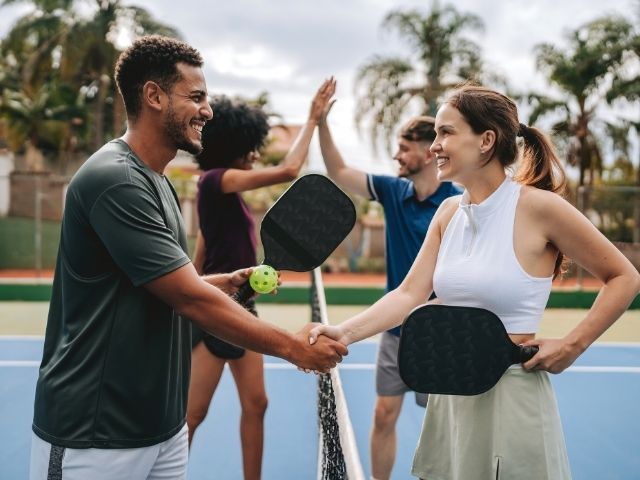
And that’s part of the attraction for a lot of people. Families and mixed-age groups (yes, while many players are older, the sport is absolutely not limited to them) enjoy that it’s an activity that crosses generations, and keeps people connected, which is pretty rare these days.
And I’ll admit, that’s partly what drew me in, too.
That, and the fact that it just looked like so much fun (more fun than running back and forth nonstop, which is what tennis always felt like to me growing up.)
We had some friends here in Venice who loved playing, and I wanted to give it a try because it seemed like a great way to get outside, get a little exercise, and meet people.
I was nervous at first… no one wants to be the “newbie”, so I signed up for a beginner class with other newcomers to learn the basics before jumping into open play. Honestly, I didn’t realize at the time just how much I’d end up loving it. Pickleball quickly became my favorite way to shake off the day’s to-do list, move my body, and have a laugh with good people.
Our little pickleball group now plays for the fun of it, with lots of jokes, cheering when someone hits an amazing shot, and plenty of laughter between points. It’s about connection rather than competition. And that’s what makes it so easy to fall in love with.
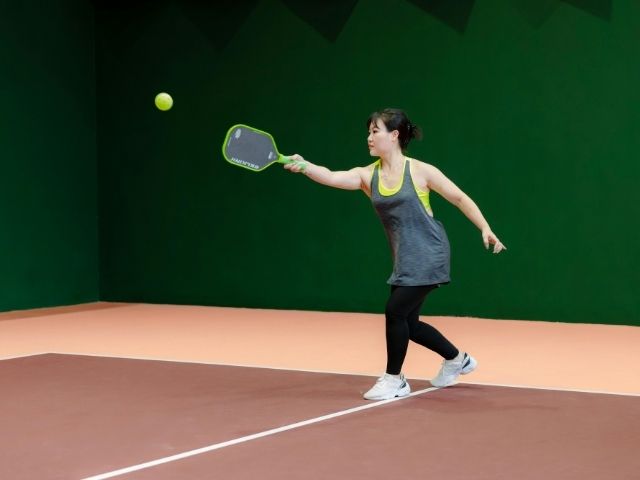
Where you can learn to play Pickleball in Venice, Florida.
Pickleball courts are popping up everywhere, and if you’ve been wondering where to play pickleball, Venice Florida has plenty of options. In fact, you’ll find tons of great places to play pickleball in Sarasota, Wellen Park, and all around Southwest Florida, whether you’re a total beginner picking up a pickleball paddle for the first time or looking to sharpen your skills.
So if you’re ready to jump in (or jump back in), here are a few great places to learn, practice, and play Pickleball in Venice, FL.
Private lessons
Many neighborhood communities, especially newer developments, resort-style and amenity-rich ones, feature instructors or coaches who will come to your court or host small group sessions. A great way to learn the fundamentals and meet people. Make sure to ask your real estate agent when viewing new homes, or the lifestyle co-ordinator if you already live in a community with a court.
Local organisations & community classes
One of the best ways (I believe) to learn pickleball in Sarasota County is through local community programs like the Sarasota County Schools ACE (Adult and Community Enrichment) Program.
This is actually where I first learned to play pickleball, and it turned out to be so much more than just a class! The ACE program offers beginner and multiple intermediate-level lessons taught by friendly, experienced instructors who really help you build confidence and have fun from day one.
Classes are usually held at local gyms or recreation centers, and they’re designed for real people, not professional athletes. You’ll learn the rules, basic techniques, and court etiquette, but you’ll also meet a great mix of locals from all over the area (not just living in the same community) who just want to get active and enjoy the game. In fact, some of my closest pickleball friends today are people I met in those ACE classes I took, and we still meet up to play every week! And they’ve introduced me to new pickleball friends too!
You can find upcoming class schedules and registration info on their website, or check your local community for similar programs.
Clinics & group sessions
Another great option for learning or leveling up your game is joining one of the local pickleball clubs that offer both memberships and instructional clinics. For example, Dill Dinkers in Sarasota is a dedicated indoor pickleball facility where you can drop in for open play, join leagues, or sign up for skill-building clinics taught by certified instructors.
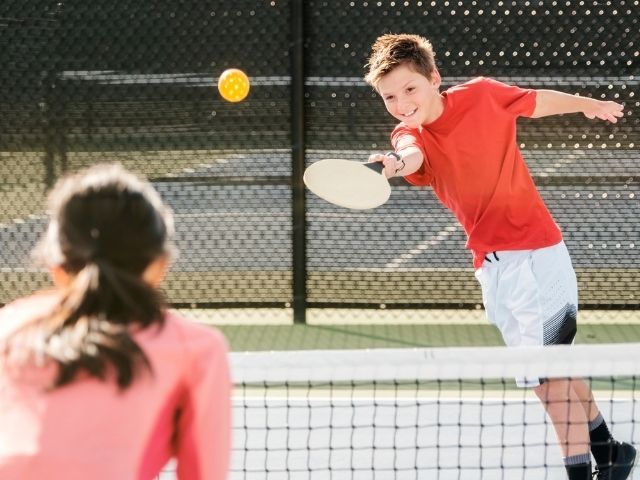
Where to play pickleball in Venice / Wellen Park / Sarasota area
Pickleball courts are popping up everywhere across Venice, Wellen Park, and Sarasota, and it’s easy to see why: the game fits perfectly into the laid-back, social Florida lifestyle. From public parks to neighborhood courts and private clubs, there’s always a place to grab your paddle and join in.
Community Courts
Many new and established neighborhoods now have their own pickleball courts built right in, which is a major bonus for residents who want to play close to home. In most cases, these courts are open only to residents (and sometimes their guests) and are maintained through community fees or HOA dues. If you’re shopping for a new home, be sure to ask about pickleball amenities as they’re quickly becoming one of the most sought-after features in Southwest Florida communities.
Neighborhood and Local Parks
If you’re not in a neighbourhood with community pickleball courts, don’t worry — many Venice and Sarasota neighborhoods and local parks have free public pickleball courts open to everyone. Some of the most popular local spots include Downtown Venice’s Herscher Park, Woodmere Park in Venice, and Laurel Park, just north of Venice.
It’s easy to join a game or just show up to hit a few balls and get the feel for it. If you’ve been wondering, ‘Where can I find pickleball courts in Sarasota?’ the Sarasota County Parks website is the best, most up-to-date resource for every public court in the area.
If you’re looking for casual matches, social drop-ins, or smaller local events, you’ll also want to check out the PlayTime Scheduler for Venice and Sarasota. It’s an easy online tool where local players post available games, meetups, and open play times at parks and clubs all over the region. It’s perfect for finding a last-minute match or connecting with other players nearby, no membership required.
Pickleball-clubs (membership model)
If you catch the bug and get serious about regular play, social events around the game, and meeting other players regularly, a club environment can be a good fit.
One of the best known in the area is Dill Dinkers Sarasota, located on Tallevast Road. It’s an indoor facility offering memberships, open play sessions, and clinics for all levels. It’s a great option if you want to beat the heat or keep your game going year-round.
Other local options include Sarasota Pickleball Club for leagues, events and skill sessions, and the GSI Institute which has a pickleball membership option within a larger fitness/wellness club.
In the Wellen Park area, the Boca Royale Golf and Country Club community has a separate racquet club that is open to the public to join! So you don’t need to live in the community to be a member of this pickleball club, but it is a huge perk for those who live there. They have fantastic facilities, equipment, pros offering classes and more. In fact, we helped a family recently purchase a home in Boca Royale specifically because they LOVED the pickleball club and wanted to be members so they could play everyday.

Why Pickleball Matters for New Homes and Community Living in Southwest Florida
When you’re looking at a new home in Southwest Florida, seeing pickleball courts in the community isn’t just about having a sport to play, it’s about everything that comes with it. A court means connection. It’s morning matches under blue skies, meeting your neighbors, staying active without feeling like you’re “working out,” and building that easy Florida rhythm into your days.
For many people moving to this area pickleball has become a social anchor. It’s often the first way newcomers meet people and feel part of their new neighborhood. And developers have caught on. These days, you’ll see pickleball courts included right alongside fitness centers, walking trails, and resort-style pools in nearly every new or planned community from Venice to Sarasota to Wellen Park and beyond.
There’s a reason for that. Communities that offer active, social amenities like pickleball tend to have higher appeal and stronger resale value. They speak to what buyers are really after – a sense of lifestyle and belonging, not just square footage.
If you’re wanting to buy a home in a community with great courts and a super active pickleball scene, then here are a few of the most popular pickleball communities to check out!
Brightmore at Wellen Park (Venice, FL – 55+ Community) has nine dedicated pickleball courts – including a stadium pickleball court where they plan to hold events and tournaments.
IslandWalk in Wellen Park – with 12 pickleball courts, this community is super active and often wins the championships for inter-community play around here!
Grand Palm (Wellen Park) – 8 pickleball courts and regular play almost every morning as well as tournaments.
Beachwalk by Manasota Key – 10 pickleball courts and a highly active community with regular play daily and tournaments too.
Wellen Park Golf & Country Club – 8 pickleball courts as well as a pro shop and on site pro who holds regular clinics and classes
Talon Preserve on Palmer Ranch (North Venice / Nokomis) – 8 pickleball courts with daily play and events to participate
The Meadows (Sarasota, FL) recently built eight brand-new pickleball courts
Why Homebuyers Want Community Pickleball Courts
Pickleball has surpassed the status of ‘amenity’ and has become part of what makes community life here in Southwest Florida feel alive. Those courts mean connection, movement, and neighbors who actually know each other. Whether it’s retirees keeping active, families playing together, or newcomers finding their circle, pickleball has become the core of many local neighborhoods. It’s a simple game that adds a whole lot of lifestyle. And really, isn’t that connection, fun, and vibrancy what we are striving for in our neighborhoods, communities, and lives?
Smart Questions to Ask When Touring a Community
Now, we’re not suggesting that you pack up and move home to facilitate your new found pickleball addiction (though I would totally understand if you had that urge). But, if you’re touring homes anyway and pickleball is part of your wish list, go beyond just checking for a court. Ask these questions instead:
- How many courts are there, and are they dedicated pickleball courts or shared with tennis?
- Are there lights for evening play?
- Does the community offer clinics or social groups for beginners or regular players?
- Are there membership fees or open access for residents?
- How busy do the courts get, and is there a reservation system?
Getting started with Pickleball
If you’re ready to dip your paddle into the world of pickleball, it doesn’t take much to begin. Check out a local park or your community courts, borrow a paddle if you need to, and maybe sign up for a beginner class. Find drop-in games and meet other players nearby, and off you go.
If you’re brand new to pickleball, my best advice is simple: stick with it. Like anything new, it takes a little practice before it starts to click, and the more often you play, the more fun it becomes. It’s tough to pick up a paddle only a few times a year and expect to improve, so try to make it a small but regular part of your week.
Even if you can only play once a week or every couple of weeks, keep at it. You’ll start to feel more comfortable on the court, get a better sense of the rhythm, and before long you’ll find yourself hooked.
If you can, find a small group of people to play with regularly, or join a class where you can learn alongside others. That consistency, and the friendships that come with it, really makes all the difference.
Most importantly, bring your fun attitude. Pickleball in Venice, Florida, and our gorgeous Gulf Coast neighborhoods isn’t just about the game. It’s about the laughter, the friendships, and those sunny mornings spent outside doing something you actually enjoy. It’s one of the simplest ways to plug into community life, stay active, and embrace everything the Florida lifestyle has to offer.
So whether you’re moving to the area, already calling it home, or just visiting for a taste of the good life, grab a paddle, step on the court, and see what all the excitement’s about. Chances are, you’ll be hooked before your first game is over. I know I certainly was.


i really enjoy reading such a greate article, keep up the wonderful work, check out my site at eiffeltower-ticketparis.com
Every weekend i used to go to see this website, because i wish
for enjoyment, for the reason that this this web page conations in fact nice funny data too. http://seosecretservice.top